
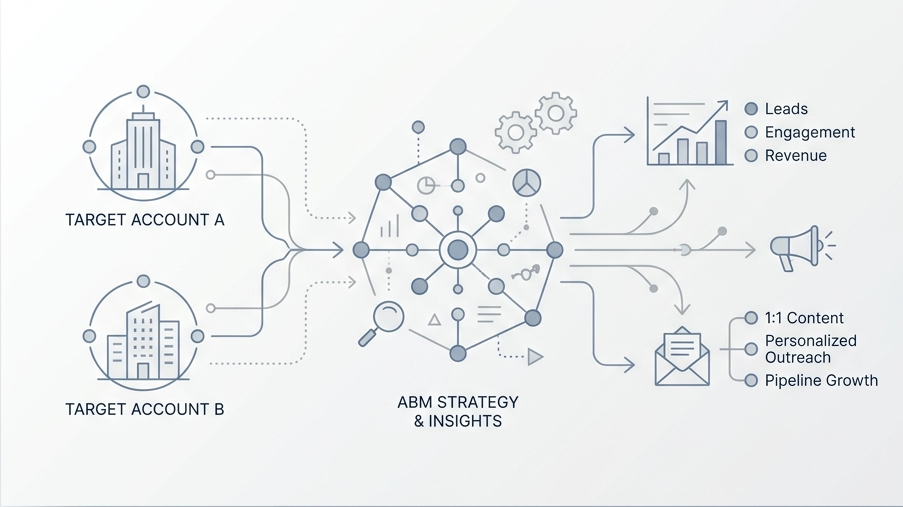
Account-Based Marketing (ABM) is one of the most effective strategies in modern B2B growth. Instead of trying to reach everyone, ABM focuses on the accounts that are most likely to become valuable customers.
That is the whole point, really. Less noise, more precision, fewer random people pretending to be prospects.
For ABM to work well, businesses need the right account data, clean targeting, and reliable segmentation. That is where GYP fits in. GYP supports ABM by helping businesses build stronger target account lists, organize data better, and improve the quality of the accounts they focus on.
In this blog, we will explain what ABM is, why it matters, and how GYP supports ABM with data-driven lead intelligence.
What Is ABM?
ABM, or Account-Based Marketing, is a B2B marketing strategy where sales and marketing teams focus on a defined list of high-value accounts instead of casting a wide net.
Rather than chasing large volumes of generic leads, ABM helps businesses focus on companies that match their ideal customer profile. ABM is about targeting the right companies with the right level of focus.
- Industry & vertical alignment
- Company size & employee headcount
- Location & geographic footprint
- Revenue & growth stage
- Buying potential & tech stack
- Decision-maker relevance & org structure
Why ABM Matters
ABM matters because broad marketing often wastes time and budget on accounts that were never a good fit in the first place.
When done properly, ABM helps businesses focus resources where conversion potential is highest. For companies selling to a specific market, ABM is one of the smartest ways to build pipeline.
- Improve lead quality by focusing on true-fit accounts
- Focus on high-value accounts with custom engagement strategies
- Strengthen sales and marketing alignment around a unified account list
- Increase conversion potential and overall deal speed
- Reduce wasted effort on poor-fit prospects and irrelevant leads
How ABM Works
A strong ABM strategy usually starts with account selection and data quality. The quality of the data behind the account list is a huge factor in whether ABM succeeds or fails.
- Define the ideal customer profile (ICP)
- Build a list of target accounts matching your criteria
- Enrich company and contact data with verified decision-maker details
- Segment accounts by priority, vertical, and revenue potential
- Align internal sales and marketing efforts for multi-channel outreach
- Track performance and continuously refine the target account list
How GYP Supports ABM
GYP supports ABM by helping businesses work with better account data. When account information is accurate, structured, and relevant, teams can focus on the right opportunities more efficiently.
1. Building target account lists: GYP helps businesses identify and organize companies that match their ideal customer profile. This makes it easier to create focused ABM campaigns around the accounts that matter most.
2. Enriching account data: Basic company names are not enough for a serious ABM program. Businesses need details like company domain, industry, company size, geography, revenue range, contact details, and key decision-maker information. GYP helps enrich this data so teams can work with a fuller picture of each account.
3. Cleaning and structuring data: ABM becomes much more effective when account data is clean and usable. GYP supports this by helping businesses organize their information in a way that is easier to use for sales, CRM, and campaign planning.
4. Segmenting accounts: Not every account deserves the same level of attention. Some are stronger fits than others, and some are simply higher value. GYP supports segmentation by helping teams group accounts based on factors like industry, location, size, value, and relevance to the ICP.
5. Improving account readiness: ABM works best when businesses have the right data in place before they begin execution. GYP helps create that foundation by supplying reliable account intelligence that teams can use to move faster and with more confidence.
Why Data Quality Is Important in ABM
ABM depends heavily on data quality. If the account list is inaccurate, outdated, or incomplete, the strategy becomes less effective.
Good data gives ABM its structure. Without it, the strategy becomes guesswork with better branding.
- Wrong company matches that waste sales representatives' time
- Duplicate records creating confusing customer journey signals
- Missing decision-maker details stalling sales pipelines
- Weak segmentation leading to generic and irrelevant messaging
- Unclear account prioritization leading to missed opportunities
- Lower overall campaign performance and diminished ROI
GYP’s Role in ABM
GYP fits into the ABM workflow as a data and account intelligence layer. That means the focus is on helping businesses build stronger prospect lists, enrich records, and organize targeting data.
This is especially useful for companies that want to improve the quality of the accounts they work on and reduce wasted time on weak-fit prospects.
- Find the right target accounts faster
- Build stronger, verified prospect lists
- Enrich company and contact records
- Organize data for precision targeting
- Support internal ABM execution with actionable intelligence
ABM Use Cases Where GYP Helps
GYP can support ABM in several practical ways across your sales and marketing operations:
- Target account selection: When a business wants to create a highly specific list of companies to prioritize.
- CRM enrichment: When teams want to improve the quality of existing company and contact records.
- Lead filtering: When businesses want to sort and focus on stronger-fit leads.
- Account segmentation: When accounts need to be grouped for more efficient planning and prioritization.
- Sales preparation: When internal teams need a cleaner list of accounts before beginning outreach or follow-up.
ABM vs Traditional Lead Generation
ABM and traditional lead generation are not the same thing. Traditional lead generation usually aims for volume. ABM aims for precision.
GYP supports ABM because ABM needs high-quality account data, and that is where the real work begins.
| Traditional Lead Generation | ABM |
|---|---|
| Broad targeting | Account-specific targeting |
| Focus on quantity | Focus on quality |
| General lead lists | Target account lists |
| Less personalization | More strategic focus |
| Wider net | Narrower, better-fit accounts |
Common ABM Mistakes
Even a strong ABM strategy can fail if the foundations are weak. ABM works best when businesses stay focused and disciplined.
- Targeting too many accounts at once
- Using bad or incomplete data
- Ignoring account segmentation
- Failing to prioritize accounts properly
- Working with outdated records
- Treating all prospects the same
FAQs
Here are answers to frequently asked questions about Account-Based Marketing (ABM) and data quality:
- What is ABM in simple words? — ABM means focusing marketing and sales efforts on a specific list of high-value target accounts.
- Why is ABM important? — ABM helps businesses improve targeting, increase relevance, and focus on better-fit accounts.
- How does GYP support ABM? — GYP supports ABM by providing clean, enriched, and organized account data that businesses can use for targeting and segmentation.
- Is ABM better than traditional lead generation? — For many B2B companies, yes. ABM is often better when quality and account fit matter more than raw volume.
Final takeaway
ABM is one of the most effective ways to focus B2B marketing on the accounts that actually matter. It helps businesses reduce waste, improve targeting, and build a smarter pipeline. GYP supports ABM by helping teams work with better account data, stronger segmentation, and cleaner target lists. If your business is serious about ABM, start with the account data. That is where everything else depends.