
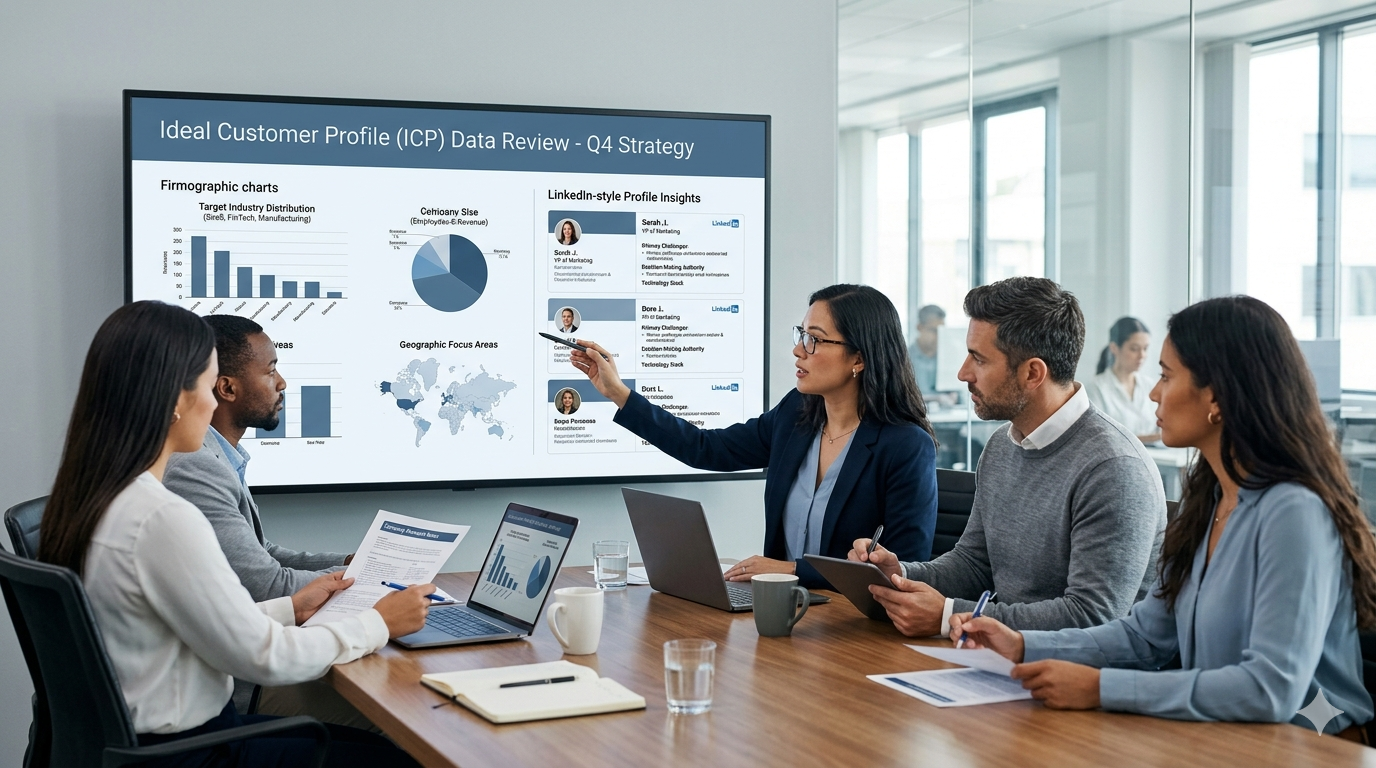
Knowing your Ideal Customer Profile is the foundation of effective B2B sales and marketing, but generic data tools often miss the details that separate a good-fit account from a poor-fit one.
The old GYP content made one point very clearly: great targeting is not built from a loose company list. It is built from careful research into industry fit, service model, buyer role, and the real-world signals that show whether an account belongs in your pipeline.
Manual ICP research adds human judgment to firmographic, technographic, and role-based data so outreach is aligned with the accounts most likely to convert.
What manual ICP research covers
Manual ICP research is a human-led process for defining and refining the characteristics of your best customers. It looks beyond broad filters to understand market positioning, buying behavior, and role relevance.
This approach is especially useful when your market includes niche segments, evolving categories, or companies whose public data does not tell the full story. A company may look like a fit on paper but still be misaligned because of service mix, team maturity, or buyer ownership.
- Industry nuances and changing market conditions
- Company size, revenue, geography, and growth stage
- Technology stack and operational maturity
- Verified decision-makers and likely buying committees
Why automated ICPs often underperform
Automated tools are useful for speed, but they tend to flatten important differences between companies. Two businesses may share the same headcount, region, and category while serving completely different buyers or operating with very different budgets and buying behavior.
That gap matters in outbound. If your targeting does not reflect the actual business model, the list may look large, but the response quality drops quickly.
- They over-rely on broad category labels
- They miss context hidden in service pages or product positioning
- They often treat outdated firmographic fields as current truth
- They do not reliably distinguish between influencers and true decision-makers
How manual research improves lead quality
Manual ICP work gives teams room to validate the story behind the data. Researchers can review company websites, hiring activity, LinkedIn profiles, and public messaging to see whether a business actually fits the campaign brief.
That extra layer is what reduces wasted outreach and makes personalization easier, because the account selection is grounded in what the company really does.
- Improves targeting by focusing on true-fit accounts instead of loose data matches
- Reduces wasted outreach to companies that are unlikely to buy
- Supports sharper messaging based on real context
- Keeps your ICP flexible as your market changes
Key steps in a stronger ICP research process
A practical ICP workflow starts by reviewing your best customers and identifying the patterns they share. From there, researchers validate those patterns in the market instead of assuming the same labels mean the same thing everywhere.
The strongest profiles combine quantitative filters with human review. That means checking websites, service pages, LinkedIn, hiring patterns, and role structure before an account is marked as campaign-ready.
- Gather core firmographics such as industry, size, revenue, and location
- Review technographics and operating signals that suggest a real use case
- Identify decision-makers and adjacent stakeholders
- Validate the account and contact data before list delivery
How to apply it in your workflow
Start with the accounts that have already closed or progressed furthest in your pipeline. Review their shared traits, then validate those patterns across a broader set of companies before turning them into campaign filters.
For best results, revisit the profile regularly. Markets shift, teams reorg, and titles change quickly, which means your ICP should evolve with your outreach strategy.
This matters even more in account-based marketing, where a small number of bad-fit accounts can waste weeks of SDR effort. Manual ICP work keeps the list narrow, intentional, and easier to personalize.
Final takeaway
Manual ICP research helps sales and marketing teams build lists that are cleaner, more relevant, and easier to personalize at scale.