
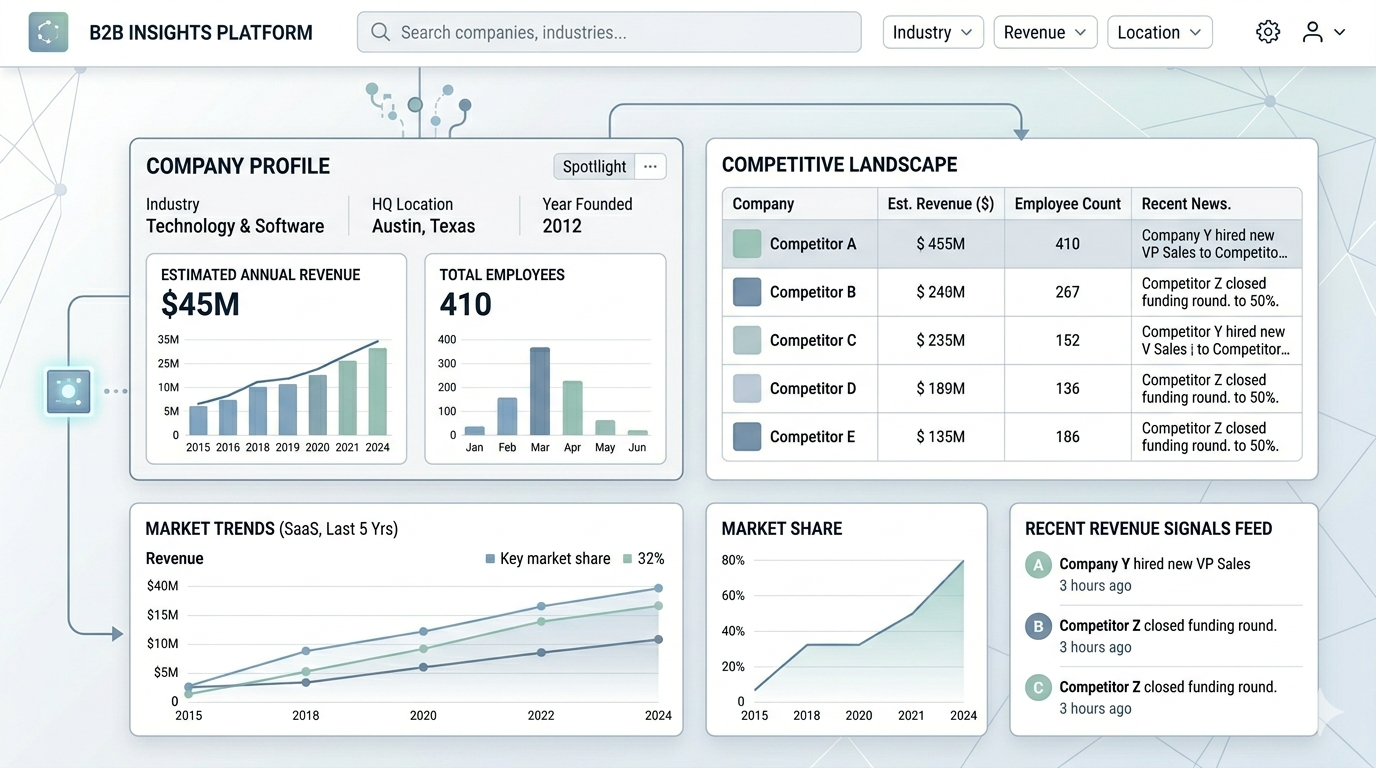
Company revenue data helps teams qualify leads, prioritize accounts, and align messaging to business maturity. For private companies, though, revenue estimates often require a mix of trusted tools and careful interpretation.
The old source material emphasized a common problem in B2B prospecting: revenue matters a lot, but private-company data is rarely clean enough to trust in isolation. That makes tool choice and manual validation equally important.
The best approach is to use revenue as one signal among several, then validate fit with additional firmographic and qualitative research.
Top tools for revenue research
| Tool | Accuracy | Best For |
|---|---|---|
| ZoomInfo | High | B2B sales and enterprise targeting |
| Dun & Bradstreet | Very high | Compliance and verified firmographics |
| PitchBook | Very high | Private company financial intelligence |
| Apollo.io | Medium | Affordable prospecting for SMB and mid-market |
| Crunchbase | Medium | Startup and funding-stage research |
What each tool is really best at
Different platforms solve different revenue-research problems. ZoomInfo is useful when revenue is part of a broader sales intelligence workflow. Dun & Bradstreet is stronger when official business information matters. PitchBook becomes more valuable when your targets are private, funded, or investment-relevant.
Apollo.io and Crunchbase are often more accessible for leaner teams, but their revenue data should usually be treated as directional. They are good starting points, not perfect sources of truth.
How to use revenue data well
- Combine revenue bands with headcount, geography, and funding data
- Use manual review for private companies with sparse public records
- Treat estimated figures as directional rather than absolute
- Validate business model fit before pushing accounts into outreach
When manual research matters most
Revenue filters are especially useful when your offer is priced for a certain company stage or team size. In those cases, a rough estimate is helpful, but your final qualification should still involve website review, category checks, and role validation.
That is where hybrid research wins: tools provide the starting point, and manual review improves confidence before lists are delivered to revenue teams.
For example, two companies with similar estimated revenue may still be completely different targets if one is service-led, one is product-led, or one is operating in a market with a very different buying motion.
A practical qualification workflow
- Start with a revenue band inside your data platform
- Cross-check employee size and market positioning
- Review the website to confirm product or service maturity
- Validate the contact roles before campaign launch
Final takeaway
The most effective prospecting workflows use revenue data as part of a broader qualification model instead of treating a single estimated number as the final answer.